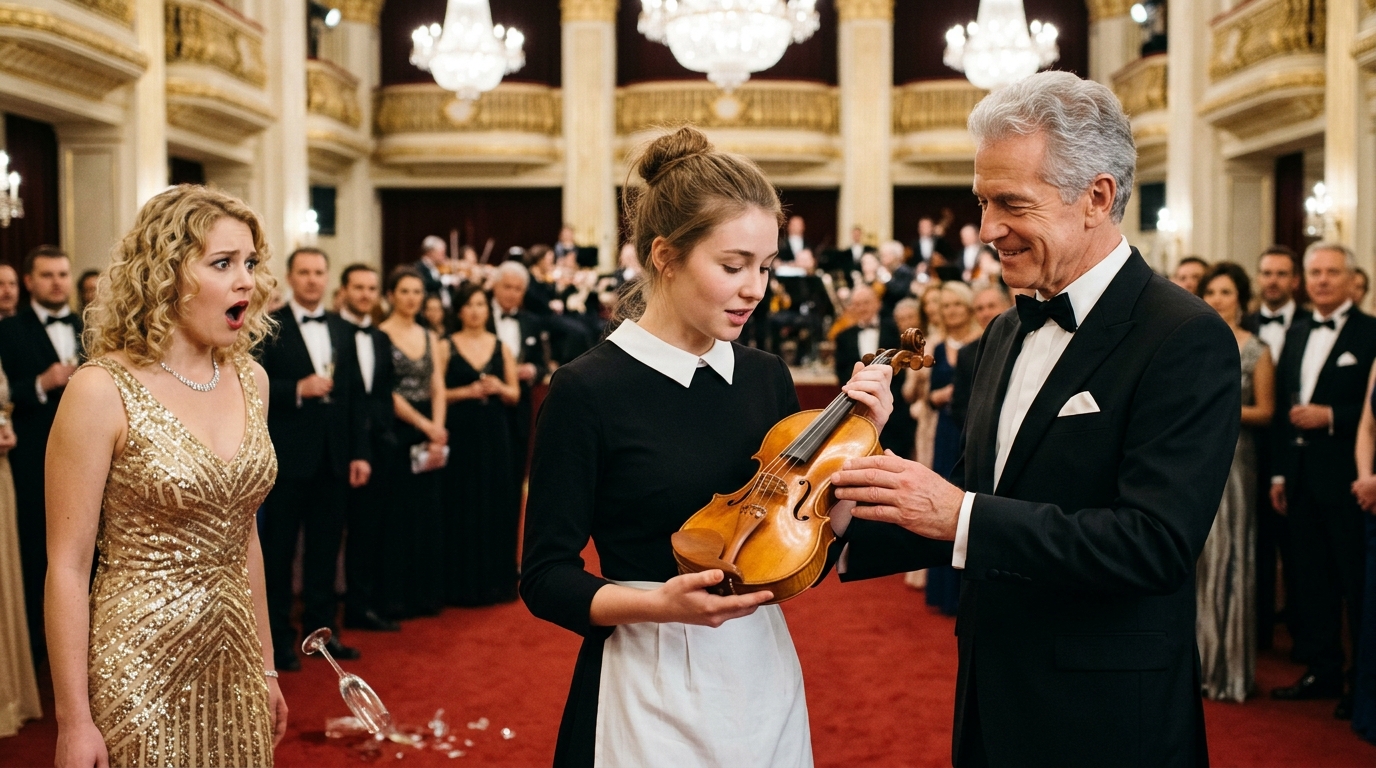
The blonde woman in the $12,000 gold couture gown stopped smiling the exact second she looked down at my left wrist.
“No…” my stepsister Vanessa whispered, her champagne flute trembling so hard the crystal chimed against her ring.
“It can’t be you.”
Beside her at VIP Table Four, her fiancé—billionaire arts patron Sebastian Alvarez—frowned.
“Vanessa?
What are you staring at?
She’s just the banquet waitress clearing the appetizer plates.”
But Vanessa wasn’t looking at Sebastian anymore.
She was staring at the thin, crescent-shaped burn scar on my left wrist as I reached for her empty porcelain plate in my black polyester catering uniform and white apron.
And then her terrified eyes darted toward the mahogany velvet case resting on the grand concert stage twenty feet away.
Inside that case lay The Nightingale of Cremona—the priceless 1789 Italian violin my late mother, Concertmaster Elena Navarro, had left to me in her will before my stepmother and Vanessa framed me for conservatory fraud, crushed my left hand in a heavy oak door five years ago, and threw me out onto the winter streets of Chicago.
PART 2 — THE MELODY STOLEN FROM MY MOTHER’S SAFE
For five long years, everyone in Chicago’s classical music world had been told that I had pawned my mother’s violin for gambling debts and vanished.
Meanwhile, Vanessa had risen to fame overnight by claiming she had “rediscovered” an unpublished violin sonata in our family attic—Sonata in D Minor for a Fallen Swallow—which she was scheduled to perform tonight in front of Maestro Julian Moretti to win the $500,000 Principal Chair Fellowship at the Symphony Gala.
“Wait a minute,” Vanessa hissed, grabbing my apron sleeve as Sebastian turned to greet the symphony director.
“You’re supposed to be waiting tables in some diner in Ohio, Aria!
Your left hand was ruined five years ago—and if you open your mouth tonight, my mother will have gala security arrest you for trespassing!”
I looked calmly down at Vanessa’s manicured fingers gripping my catering apron.
“You didn’t find Sonata in D Minor in the attic, Vanessa,” I said softly.
“I composed it when I was seventeen years old for my mother’s fiftieth birthday.”
“And you forgot to compose the third movement—because the third movement was never written on paper.”
Before Vanessa could reply, the crystal chandeliers dimmed across the grand ballroom of the Drake Hotel.
Four hundred guests burst into applause as Maestro Julian Moretti—the legendary seventy-year-old conductor who had once toured Europe with my late mother—stepped onto the podium and invited Vanessa to the stage.
WHEN THE SPOTLIGHT HIT THE STAGE
Wearing a triumphant smirk, Vanessa glided up the stage steps, lifted my mother’s 1789 Cremona violin under her chin, and began to play the first two movements of my stolen sonata.
I stood quietly beside the kitchen service doors holding my silver tray.
To the casual society guests sipping champagne, Vanessa sounded polished.
But at the conductor’s podium, Maestro Julian Moretti’s brow furrowed deeper with every measure.
When Vanessa finished the second movement and lowered her bow with a rehearsed curtsy, Maestro Moretti didn’t applaud.
He stepped to the stage microphone.
“Miss Sterling,” Maestro Moretti said, his resonant voice echoing through the silent ballroom, “when you submitted this score for the Principal Fellowship, you claimed you composed it in honor of the late Elena Navarro.”
“Of course, Maestro!”
Vanessa beamed into the spotlight.
“That is fascinating,” Maestro Moretti replied dryly, “because Elena Navarro played the first two movements of this exact piece for me in Vienna six months before she died—and she told me that only her biological daughter, Aria, knew the unwritten third movement: The Cadenza of the Harmonic Key, which can only be played using the double-stop fourth-finger technique Elena invented.”
Vanessa’s face went dead white under the stage lights.
“I—I hurt my wrist during rehearsal this morning, Maestro!”
Vanessa stammered.
“Nobody living can play that fourth-finger harmonic!”
“I can,” I said clearly.
PART 3 — THE WAITRESS STEPPING INTO THE SPOTLIGHT
Every single head in the four-hundred-seat ballroom turned toward the kitchen service doors as I set my silver tray down on Table Four, untied my white catering apron, and walked up the mahogany steps onto the stage.
In the front row, my stepmother Victoria half-rose from her chair, her hand flying to her throat.
“Security!”
Victoria shouted.
“Stop that waitress!
My stepdaughter is mentally unstable!”
Maestro Julian Moretti took one look at my face—and then at the way I naturally curved my left fingers—and his eyes filled with tears.
“Aria Navarro?” the Maestro whispered.
“Hello, Uncle Julian,” I said softly.
Sebastian Alvarez stood up at Table Four, staring at his fiancée Vanessa in dawning horror.
“Vanessa… you told me Aria Navarro died three years ago!”
Sebastian demanded.
Ignoring Victoria’s screams, Maestro Moretti lifted the 1789 Cremona violin from Vanessa’s frozen hands and placed it gently into mine.
“Show them who owns this soul, child,” the Maestro said.
I tucked my mother’s violin beneath my chin.
For five years, while working twelve-hour shifts washing dishes and carrying banquet trays, I had spent two hours every midnight rehabilitating my crushed left fingers with physical therapy until my tendons were stronger than iron.
I drew the horsehair bow across the strings.
From the first weeping harmonic note of the unwritten third movement, the entire ballroom stopped breathing.
The violin sang like a human voice rising from the ashes—soaring through triple-stop cadenzas that made three first-chair violinists in the orchestra openly weep.
PART 4 — THE MICRO-ENGRAVING INSIDE THE SOUNDPOST
When the final high D harmonic lingered in the rafters and faded into silence, all four hundred guests—led by Sebastian Alvarez himself—rose in a thunderous standing ovation.
Vanessa backed toward the stage curtain, trembling with rage.
“So what if she memorized a tune?!”
Vanessa screamed over the applause.
“Her father signed the legal bill of sale leaving the 1789 Cremona violin and the Navarro Estate Trust to my mother!”
“Actually, he never signed a bill of sale,” I said into the stage microphone.
I loosened the E-string peg slightly, pressed a tiny hidden ebony latch built into the tailpiece—a secret only my mother and the luthier in Cremona knew—and slid a rolled parchment certificate out of the hollow endpin compartment.
“Before my mother passed away,” I announced as Maestro Moretti held the certificate under the stage document camera, projecting it onto the giant screen behind the orchestra, “she recorded the violin’s serial number and her $4.2 million royalty trust with the International Registry of Historic Instruments in Geneva.”
“And she sealed the original forensic handwriting report inside the tailpiece—proving that Victoria Sterling forged my father’s signature on the estate transfer while he was sedated in intensive care!”
At Table Four, Sebastian Alvarez calmly slipped the five-carat engagement ring badge off his table place card, walked to the foot of the stage, and signaled the two state fraud prosecutors who served on the Symphony Board.
Within ten minutes, Vanessa and her mother Victoria were escorted out through the hotel lobby in front of flashing press cameras.
Maestro Julian Moretti handed me the $500,000 Principal Fellowship check and my mother’s violin case.
And for the first time in five years, I didn’t leave through the kitchen service door.
I walked out the front marble staircase with my mother’s music alive in my hands.