For three long seconds on the wind-swept tarmac, nobody moved.
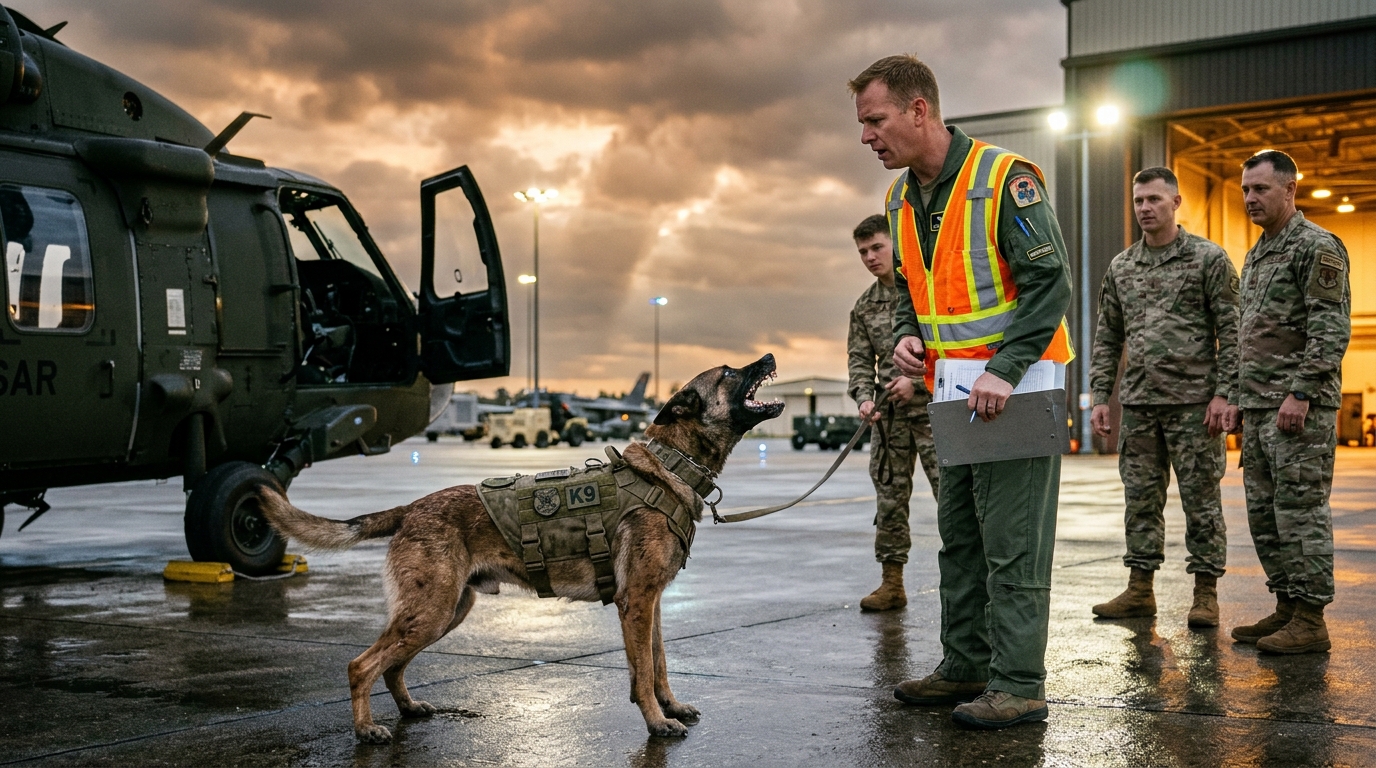
The twin rotors of the VIP Black Hawk transport helicopter beat the evening air above us, sending dust spiraling across the airfield, yet twelve military officers stood frozen beside the boarding steps.
At my boots stood Ranger.
Nine years old, scarred across his left shoulder from an IED in Kandahar, with a graying muzzle that had prompted Captain Daniel Voss to sign his mandatory retirement papers that very morning.
Ten minutes ago, Captain Voss had laughed in front of the entire flight line and called Ranger “a half-blind museum piece taking up kennel space.”
Now Ranger wasn’t trembling.
His ears were pinned flat.
His lips pulled back over his canines, a deep, vibrating growl rolling from his chest.
And he had planted all seventy-five pounds of his scarred Belgian Malinois frame squarely across the helicopter’s steel boarding step—blocking Brigadier General Evelyn Shaw from stepping inside.
“Sergeant Walker, get that defective animal off my flight line immediately!”
Captain Voss barked over the roar of the turbines, reaching for his sidearm holster.
General Shaw raised one gloved hand.
“Wait,” General Shaw said sharply, looking down at the old dog.
Because Ranger wasn’t barking at General Shaw.
Ranger’s dark, unblinking eyes were locked dead onto Captain Daniel Voss—the chief aviation maintenance officer who had personally signed the helicopter’s final pre-flight safety release twenty minutes earlier.
PART 2 — WHAT THE OLD DOG SMELLED ON THE CAPTAIN’S GLOVES
“What exactly is that dog doing, Sergeant Walker?”
General Shaw asked me, stepping back onto the concrete apron.
My heart hammered against my ribs.
In six years as Ranger’s handler—and four years before that when Ranger served alongside my late father, Master Sergeant Michael Walker—I had never once seen Ranger give a false aggression alert.
Not once.
Instead of pulling Ranger back, I dropped to one knee beside his tactical vest and gave the hand signal my father had taught him in 2018:
Seek source.
Ranger didn’t lunge at Captain Voss’s throat.
Like a laser-guided missile, the nine-year-old K9 darted past Captain Voss’s boots, leaped onto the maintenance step beneath the helicopter’s tail rotor gearbox, and began scratching violently at the lower hydraulic inspection panel—barking three sharp, rhythmic bursts.
Three barks.
The military K9 code for nitrate-based plastic explosive residue.
The maintenance technician standing beside the fuel cart turned white as a sheet and dropped his wrench onto the concrete.
Captain Voss took a half-step backward toward his staff jeep.
“He’s senile, General!”
Captain Voss shouted, sweat beading on his forehead despite the cold Montana wind.
“That panel was sealed and inspected by my crew at 1600 hours!
We are on a strict flight schedule to Redstone!”
“Nobody moves from this tarmac,” General Shaw commanded, turning to her Military Police escort.
“Master Chief, unbolt that tail hydraulic panel right now—and two of you stand beside Captain Voss.”
INSIDE THE TAIL ROTOR COMPARTMENT
While two MP sergeants flanked a pale, sweating Captain Voss, the Master Chief unscrewed the four titanium fasteners on the tail inspection plate and shone his tactical flashlight inside.
For two seconds, the Master Chief didn’t speak.
Then he slowly backed away, his face drained of color.
“General Shaw… shut down the turbines immediately!” the Master Chief yelled.
“Somebody wired a barometric thermal charge around the primary tail-rotor hydraulic line!
The second this aircraft climbed above four thousand feet over the mountain pass, the hydraulic line would have severed—and it would have looked like a routine mechanical crash!”
General Shaw’s eyes narrowed to ice as she turned toward Captain Voss.
“You cleared this aircraft personally at 1630 hours, Captain Voss,” she said quietly.
“And you insisted on transferring Sergeant Walker and his K9 off this base this morning before my inspection team arrived.”
PART 3 — THE UNDERGROUND HANGAR AND MY FATHER’S FILE
Suddenly, Ranger stopped barking at the helicopter.
The old dog lowered his nose to the concrete, sniffed the grease trail leading from Captain Voss’s boots, and trotted twenty yards across the tarmac toward Hangar 4B—the decommissioned cold-storage bunker that had been padlock-sealed since the night my father, Master Sergeant Michael Walker, supposedly died in a training helicopter crash on this exact mountain range three years ago.
Ranger sat down in front of the rusted steel keypad door of Hangar 4B and let out a long, haunting whine.
I stared at Captain Voss.
Three years ago, Captain Voss was the officer who had signed the inspection log on my father’s helicopter, too.
“Open Hangar 4B,” General Shaw ordered the MP commander.
“General, that bunker is condemned—there’s nothing in there!”
Voss protested wildly, struggling as the MPs pinned his arms behind his back.
When the MPs cut the padlock and rolled back the heavy steel door of Hangar 4B, the beam of my flashlight illuminated stacks of unmarked wooden crates bearing scratched-out serial numbers from the base armory.
And sitting on a steel desk in the center of the bunker was a laptop logged into an offshore smuggling ledger—alongside my late father’s missing bronze dog tags.
PART 4 — THE VOICE RECORDING ON THE METAL TAG
I picked up my father’s dog tags with shaking fingers.
Taped between the two metal tags was a tiny micro-SD card my father had hidden there the night before his fatal flight—and which Voss had kept locked in his private bunker trophy box after recovering the wreckage.
When General Shaw’s intelligence officer slotted the card into a field tablet, my father’s voice filled the silent hangar:
*“If anyone finds this tag on Ranger’s collar or in my gear, Captain Daniel Voss and the base logistics contractor have been swapping defective counterfeit rotor blades and selling military guidance hardware overseas.
If my bird goes down tomorrow, check Hangar 4B.”*
General Shaw looked at the scarred nine-year-old Malinois sitting proudly beside my knee, then looked at Captain Voss as the MPs locked leg irons around his boots.
“My father trained Ranger to recognize the exact chemical solvent Voss uses on his explosive timers,” I said softly, burying my hand in the thick gray fur around Ranger’s neck.
“Voss tried to have Ranger put down as ‘unfit for duty’ this morning because he realized Ranger recognized his scent the moment he walked onto the flight line.”
Two weeks later, Captain Voss and four co-conspirators were arraigned before a general court-martial for treason, sabotage, and the premeditated murder of Master Sergeant Michael Walker.
My father was posthumously awarded the Distinguished Service Cross.
And Ranger?
Instead of being locked in a retirement crate, the nine-year-old K9 stood beside me on the parade ground as General Shaw pinned the Military Working Dog Medal of Gallantry onto his crooked tactical vest—before he came home to sleep on the rug in front of my fireplace for the rest of his life.